
Your Readers Can Tell Claude Is Talking
Half the teams I talk to have fixed the em dash and think they’ve fixed the writing.
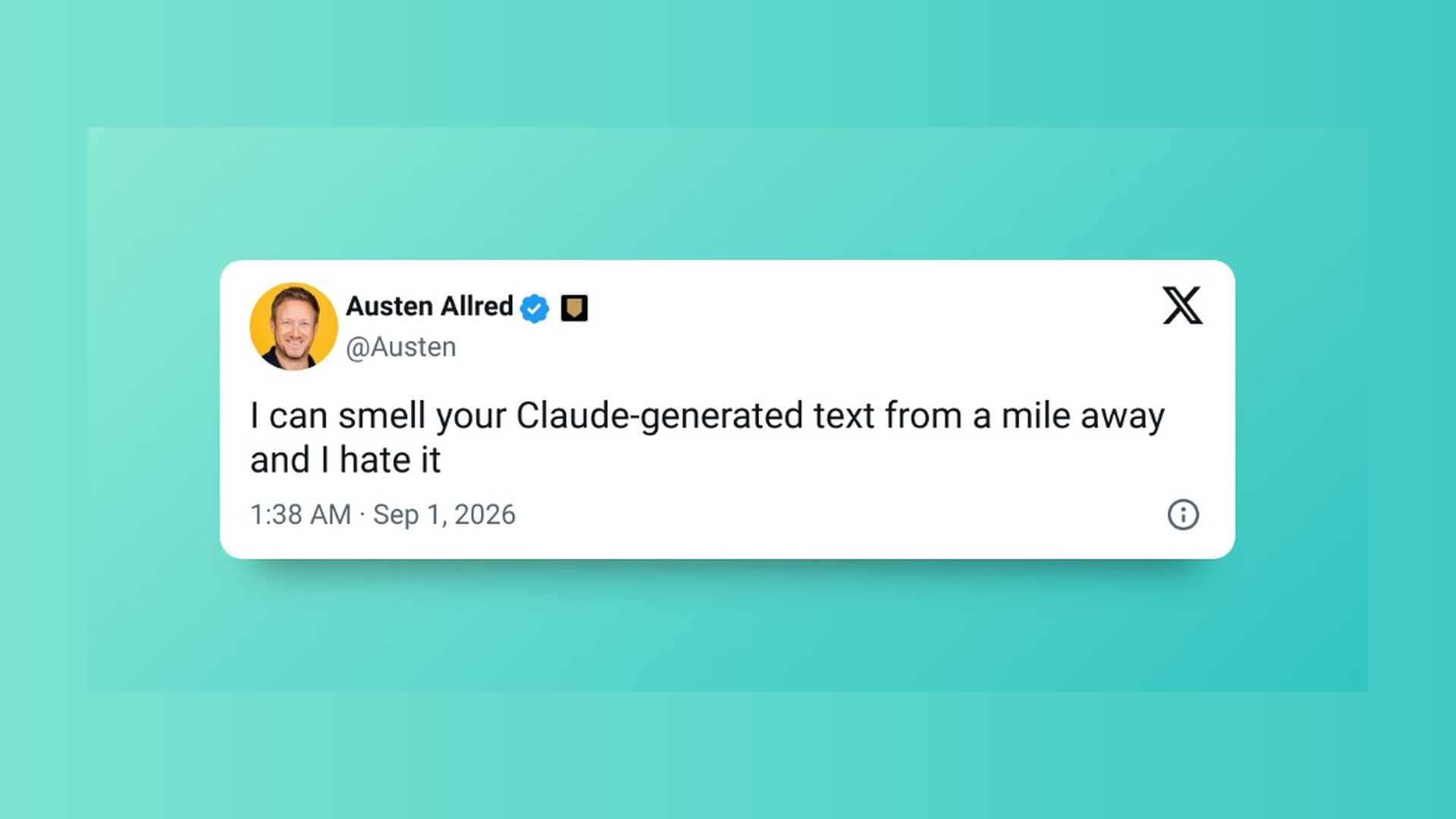
Austen Allred posted this week that he can smell Claude-generated text from a mile away. I know the smell. You probably do too. Everyone is using Claude now, or ChatGPT, or both. The writing comes out snappy. Clean. A little too pleased with itself.
Then a tell shows up and you fall out of the story. The sentence that explains the sentence before it. The setup that already sounds like it decided you agree. “That’s the most important ____ in this ____.” Suddenly you know the model is talking, not the writer.
That isn’t a style nitpick. That’s the reader leaving the narrative. Now they’re wondering whether these are even your ideas.
The message loses
Stanley Druckenmiller had a Wall Street Journal op-ed last week about Treasury buybacks and the debt. Serious argument from a serious investor. Then readers clocked the prose. He said, sure, he used AI, the way you’d use a calculator.
Right or wrong, the conversation left economics and went to the tool. The message was lost.
If that can happen to a bond-market argument in the Journal, it can happen to an email, a board update, or a story about something that matters in your community.
For mission-driven organizations there’s a worse version. These models reach for whatever already works in a feed, and what works in a feed is fear, uncertainty, and doubt. FUD has been the default register of fundraising copy for decades, and the models learned it long before anyone at your organization opened a chat window.
If you’re not careful, it seeps in. The reader notices the machine. Worse, the person whose story you’re telling gets a version they never agreed to. That’s not a branding miss. That’s a real risk of re-harming someone who trusted you with their story.
People keep trying to fix this in the prompt. Kill the em dash. Add “sound like a human.” Paste in a paragraph of brand adjectives. That helps for a sentence. It doesn’t hold for a team.
What actually holds
The floor I keep coming back to is unglamorous.
Team accounts. If the work lives in one person’s chat, you don’t have a system. You have a hobby. The next person can’t pick it up and the next agent can’t either. A team account gives you shared projects, skills, connectors, and memory, which is the whole point.
Skills. Write down how you actually do the thing. The sequence, the checks, what “done” looks like. A skill is a repeatable way of working, not a clever prompt you used once and lost. If you haven’t built your brand voice as a skill in Claude or ChatGPT, that’s the single biggest unlock available to you right now.
Shared context. The Tuesday decision. The client you don’t talk about that way. The offer as it actually is, not the internet’s average of your industry. If that lives in one person’s head, the model will guess, and guessing is where the snappy, empty copy comes from. Gathering and maintaining documentation about your company, your programs, your services, and the current state of your accounts is called context, and context is what lets your AI get it right.
Most organizations are running bring-your-own AI. People use different apps, prompt differently, and feed the model their own slice of what’s happened in the business. Some of them are shipping proprietary data or personal information to third parties without knowing it. That’s a separate problem, and a big one.
Here’s a test. Ask two people on your team the same question this week: who are we, and who’s it for? Have them use whatever AI they normally use. You’ll get two different answers, and neither will be wrong exactly. They’ll be built from two private histories of context. The model isn’t confused. It’s answering from whatever got typed into it last.
A voice file that’s more than “no em dashes.” The em dash rule is real. It’s also the smallest part. A voice file worth using says who you serve, what you will not say about them, where FUD is a hard no, and what a good sentence sounds like when it’s you. It has the phrases you actually say and the ones you avoid. Examples, not a mood board.
When we built GoldenDoodle AI, our platform for trauma-informed nonprofit communications, we mapped brand voice across 34 distinct dimensions before it generated a single word for a client. That’s more granular than most teams will ever need. It’s also proof the depth is real, not a slide with adjectives on it.
AI is good at closing the gap between knowing the next action and taking it. It is not good at inventing context you never captured. Judgment stays human. The floor is what lets the tool stay in its lane.
Whether it’s ChatGPT or Claude in your shop, the question isn’t whether to use it. You’re using it. The question is whether the next person, or the next agent, has to guess.
The layer underneath
This is how work runs at MKTNG now. Not “AI-powered content.” The layer underneath it: one place where your knowledge, your positions, and your real voice live, connected to the tools your team already uses, so the answer comes from your record instead of the model’s best guess.
We call it a brand brain, and it’s what we’re building for clients. It’s the difference between a team that’s faster at pulling in different directions and a team that’s faster together.
If that’s missing where you work, we can map it in a working session. One afternoon, your real knowledge and your real voice, one assistant standing up before you leave the room.
What would you have to write down once so the people you serve still sound like themselves?