
What Makes an Agent-Ready Website?

An agent-ready website is one an automated agent can parse to answer buyer questions without breaking: clear service pages, consistent contact and location data, crawlable HTML, predictable URLs, and permissions that match what you actually allow bots to do. “Agent ready” is a site quality bar, not a plugin you install once.
Key takeaways
- One URL per service with a plain H1, answer paragraph, proof, and CTA.
- Name, phone, and service area match across footer, contact, and structured data.
- Critical content lives in HTML, not only in PDFs or heavy client-side scripts.
- Optional llms.txt only when someone will maintain it after every URL change.
Why agent-ready matters now
Buyers ask ChatGPT before they ask your contact form. Sales agents and support agents inside your company will read your site the same way. If structure is messy, agents guess, and guesses become wrong quotes about what you sell.
Cloudflare runs a free agent readiness check at isitagentready.com. You give it a URL, and it tests the site against 22 emerging standards in five categories.
| Category | What it checks |
|---|---|
| Discoverability | robots.txt, a sitemap, Link response headers, and DNS records for AI discovery |
| Content accessibility | Whether the site sends clean Markdown to an agent that asks for it. llms.txt is only checked if you add it in a custom scan. |
| Bot access control | AI bot rules in robots.txt, Content Signals, and Web Bot Auth |
| API, auth, and MCP discovery | Ways for an agent to find and use what your site offers, such as an MCP Server Card, Agent Skills, an API catalog, and OAuth metadata |
| Commerce | Payment protocols for agents, such as x402 |
The result is a level from 0 to 5. Level 1, Basic Web Presence, needs two of robots.txt, a sitemap, and Link headers. Level 2, Bot-Aware, adds AI bot rules and Content Signals. Level 3, Agent-Readable, adds Markdown negotiation. Level 4, Agent-Integrated, adds at least one integration an agent can use, like an MCP Server Card or Agent Skills. Level 5, Agent-Native, asks for two of these: Web Bot Auth, all four Level 4 integrations, or auth metadata. The commerce checks don’t change the level.
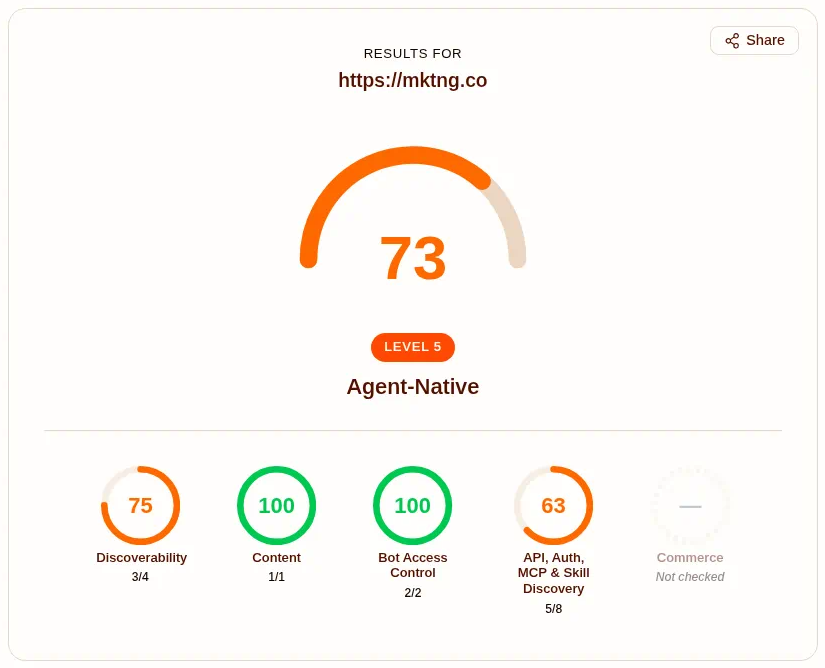
The login checks only matter if your customers have accounts. Most service businesses don’t, so skip them. What counts is whether an agent can reach you: send a message, book a call. That’s what we added.
The check doesn’t look at page speed or security, and a high level won’t get you cited by itself. We still like it as a yardstick, because nobody selling you a website wrote it, and every failed check comes with instructions you can hand to whoever runs your site.
What belongs on an agent-ready site
Service clarity. One URL per offer, plain H1, answer paragraph, proof, CTA. No orphan PDFs that contradict the HTML.
Entity consistency. Name, address, phone, service area, and hours match on contact, footer, and structured data.
Technical baseline. HTTPS, mobile layout, Core Web Vitals within reason, no critical content loaded only after heavy JavaScript.
Discovery files. robots.txt and sitemap that reflect what you want indexed. Optional llms.txt only if you will maintain it (see should you add an llms.txt file).
Agent discoverability inside AEO. Structured FAQ, Organization schema, and internal links that describe services in words buyers use.
Agent-ready website checklist
- Home and top service URLs return fast HTML with matching titles and H1s.
- Contact page lists one phone, one city, and service area in plain text.
- Each service page opens with a 40 to 60 word answer buyers can quote.
- Sitemap includes only URLs you want indexed; no duplicate service paths.
robots.txtallows crawlers you care about for AI search features.- FAQ answers are visible in HTML, not hidden in accordions.
AI agent ready website vs marketing microsite
A microsite built for a campaign often lacks the durable facts agents need: legal entity, full service list, leadership, policies. Agent-ready work usually means strengthening the main domain, not spinning up a thin landing page.
Can AI agents log in to websites or scrape them?
Some agents browse logged-in areas if you give them credentials. That is a policy choice, not a default. Public agent-ready work focuses on what should be public anyway. Scraping without permission is a legal and brand risk; publish what you want quoted.
How we build toward agent-ready
How we build sites that AI agents can read includes performance work, answer-shaped copy, schema, and agent discoverability review on the primary domain. Every agent we deploy for clients still runs on Groundwork for company knowledge; the public site is how strangers and models first verify you exist.
Pair with getting your business recommended in ChatGPT and the difference between AEO and SEO.
Questions we get
What is an agent ready website?
A site structured so automated systems can list your services, location, and proof without conflicting sources.
Is agent-ready the same as AEO?
Agent-ready describes site quality. AEO is the broader practice of earning citations in AI answers. Agent-ready sites make AEO easier.
Does Cloudflare agent ready website score replace SEO?
No. It checks technical standards that help AI agents find and read your site, like robots.txt rules, sitemaps, and Markdown negotiation. It says nothing about whether your pages answer a buyer’s question, which is the work SEO and AEO do.
Do I need llms.txt to be agent ready?
No. A maintained sitemap and clear HTML matter more. Add llms.txt only if you will keep it current.
Where do I start?
Run the public checklist on your home and top three service URLs, fix entity mismatches, then add answer blocks and FAQ.
It starts with a Working Session.
One conversation about where you want AI to take the work, and what you are working with today.
Book a Working Session