
The Proposal Is the Demo: proposals.mktng.co
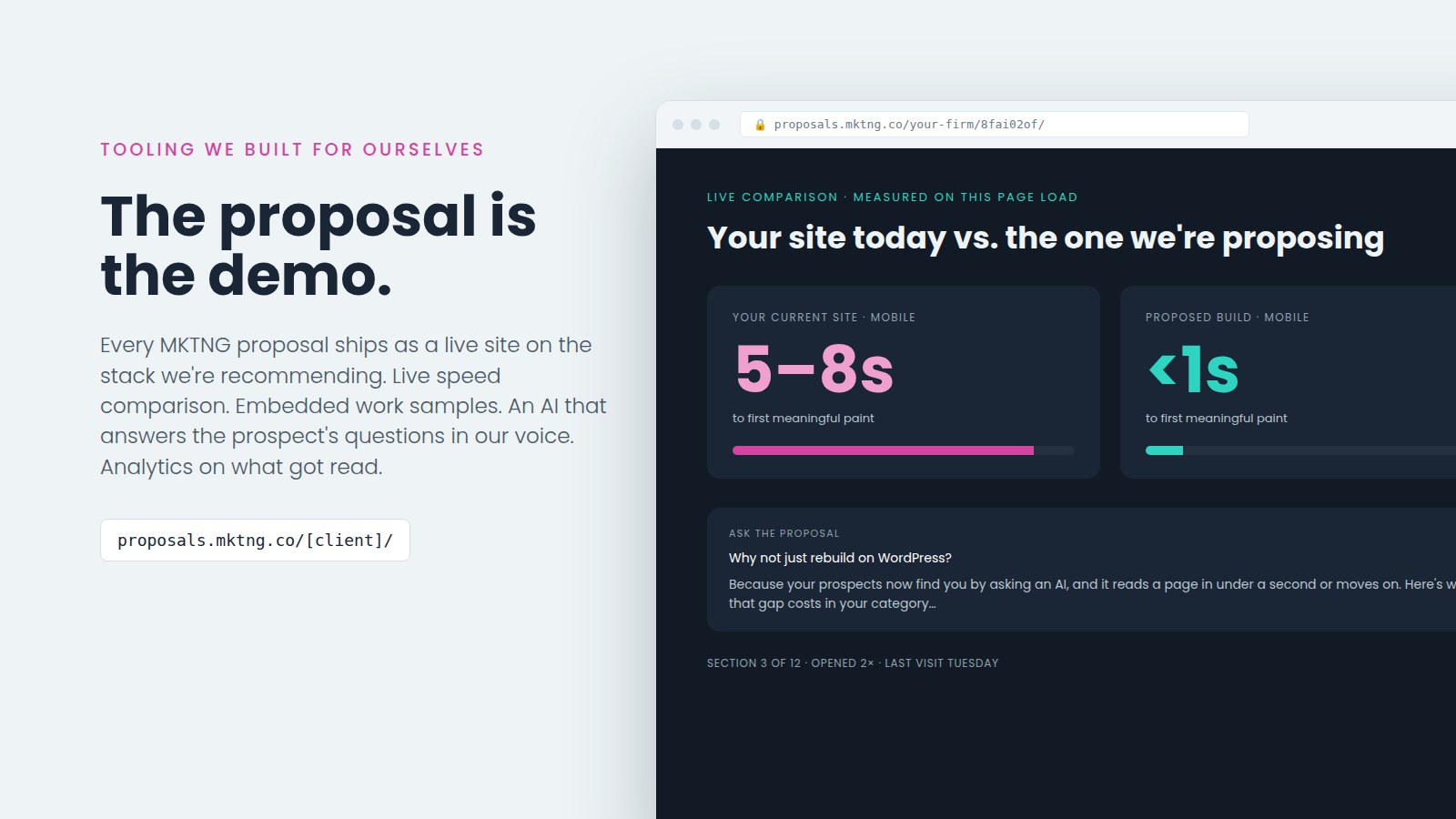
Every agency proposal has the same problem. It’s a PDF describing a website, and the PDF is slow, static, and unreadable on a phone, which is exactly what the agency is promising to fix. We were selling fast, modern, interactive sites with a document that was none of those things. So we stopped.
| Format | One live site per proposal at a private, unguessable address |
| Time from brief to live proposal | About 60 minutes once the recommendation is decided |
| Live on-page comparisons | Prospect’s site speed vs. ours, pulled fresh on every load |
| Prospect questions answered on-site | AI Q&A trained on the proposal, in our voice |
| What we see | Opens, sections read, return visits, calendar clicks |
| Secondary deliverables | PDF for forwarding, audio summary for the drive home |
Each proposal now lives at its own address on proposals.mktng.co, on the same infrastructure we’re recommending to the client. See how we build proposals for clients. That’s not a format preference. A prospect who opens it is test-driving the thing we’re proposing to build.
Inside, the proposal does what a PDF can’t. It pulls the prospect’s current site speed and ours on page load, so the gap isn’t a screenshot, it’s the actual number every time they look. Work samples are the real sites, embedded, not screenshots of them. An AI trained on the proposal answers “why not WordPress” or “what happens in month two” in our voice, with our specifics, at whatever hour the prospect is reading. And because the whole thing is instrumented, we know when it was opened, which sections held attention, whether the decision-maker came back, and whether anyone clicked to book a call.
That last part changed how we sell. When a proposal has been open twice and the investment section was read both times, the follow-up writes itself. When it hasn’t been opened, we know that too, before the deadline instead of after.
The platform runs on the same foundation as everything else we build. Proposal content lives as structured, portable files, so a new proposal is a configuration of a proven template rather than a document started from scratch, and every improvement to the template shows up in the next one. Same pattern as our revenue agents and our client sites: build the core once, put a thin layer on top for the specific job.
We built this for ourselves first because that’s how we build everything. If it didn’t make our own sales process measurably better, it wasn’t going to a client.